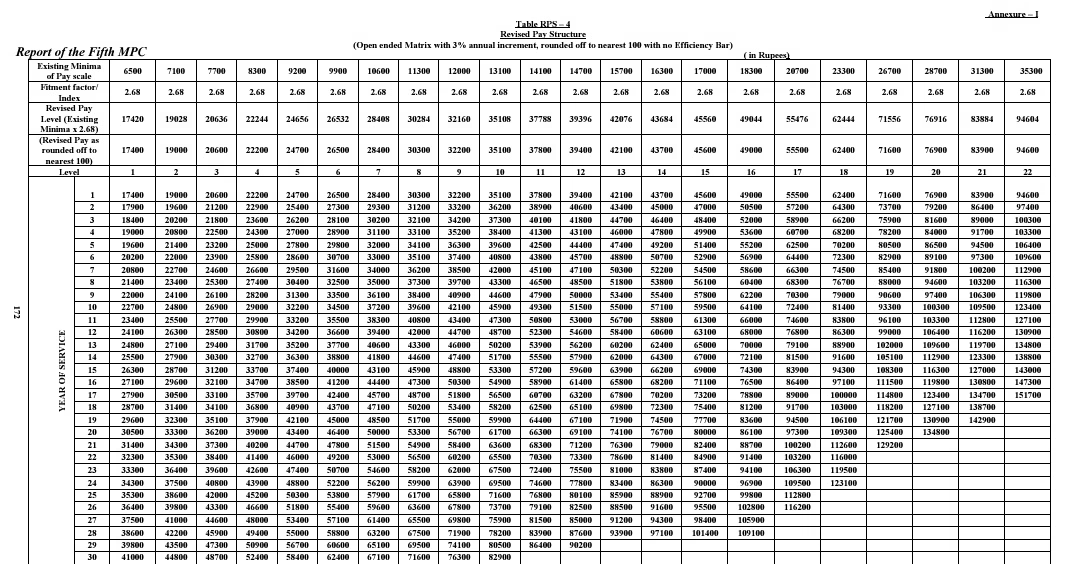
Download Meghalaya Pay Matrix Table
Meghalaya Government Salary Calculator
Meghalaya Pay Matrix (Levels & Increments)
Meghalaya’s revised pay structure (effective Jan 1, 2017) uses a Pay Matrix with 22 levels. Level 1 covers the lowest grades (e.g. Group D posts) and Level 22 covers the top grades. Each level has multiple cells (steps) that represent incremental pay. Under the new rules, employees receive one annual increment (~3% of basic) on either 1st January or 1st July each year, depending on their date of appointment. In other words, there are two possible increment dates (Jan 1 and Jul 1) instead of only July 1. For example, an employee appointed between Jan 2 and Jul 1 gets the next raise on the following Jan 1; if appointed after Jul 1, the raise comes on the next Jul 1. Over time, these increments help an employee progress upward within the pay level (roughly a 3% jump each year).
In this matrix, the minimum basic pay (Level 1 entry) was fixed at about ₹17,400, while the highest level (Level 22) goes up to roughly ₹94,600 at the top of the scale. This reflects a 1:5.4 ratio between the lowest and highest basic pays in the matrix. In practice, a Level 1 entry-level employee starts at ~₹17,400 basic, whereas top-level officers draw basic pay approaching ₹94,600 (before any increments).
Salary Calculation: Basic Pay & Allowances
An employee’s gross salary is calculated by adding allowances to the basic pay from the matrix. Key components are:
- Basic Pay: Determined by the Pay Matrix level and cell. (For example, Level 1 starts at ~₹17,400; Level 10 and Level 22 start much higher.)
- Increments: One annual raise (~3%) as noted above. Over years, this steadily increases the basic pay.
- Dearness Allowance (DA): A cost-of-living allowance linked to inflation. As of mid-2025, DA is 51% of basic pay (after recent hikes). (The state raised DA from 43% to 46% in July 2024 and then to 51% in July 2025.) DA is applied to basic pay (and adds substantially to gross salary).
- House Rent Allowance (HRA): A percentage of basic pay based on location:
- Shillong and Urban Agglomeration: 15% of basic (capped at ₹8,000 per month).
- District HQ: 12.5% of basic (max ₹6,000).
- Other areas: 10% of basic (max ₹5,000).
- Medical Allowance: A flat ₹1,000 per month for all employees.
- Hill Compensatory Allowance: A flat ₹500 per month for all state employees (regardless of posting) to compensate for hilly terrain.
- Winter Allowance: ₹600 per month for four winter months (November–February) for those posted at high altitudes (≥1000m). This also applies to pensioners living in those areas.
- Other Benefits: Employees also get benefits like Provident Fund, pension contributions, leave encashment, etc., similar to other government services. (For example, provident fund contributions are deducted from basic+DA.)
A typical gross monthly salary is calculated as:
Gross Salary = Basic Pay + DA + HRA + Medical + HCA + Winter (if eligible) + other allowancesFor example, a Class III officer with basic ₹30,000 at Shillong would get DA (say ₹15,300 at 51%), HRA (15% of ₹30,000 = ₹4,500), plus ₹1,000 medical and ₹500 HCA, yielding a gross of ₹51,300 (before any deductions).
Meghalaya’s Pay Commission vs 7th CPC
Meghalaya does not use the 7th Central Pay Commission (CPC) scales. Instead, the state adopted its own Fifth Meghalaya Pay Commission recommendations in 2017. All state employees were placed in the new state Pay Matrix as per the 5th Commission from Jan 1, 2017. (In fact, the 5th Commission report set Level 1 at ₹17,400 and Level 22 at ₹94,600.) The state government has since announced it will constitute a Sixth Meghalaya Pay Commission to review pay structures in coming years.
In contrast, many other states and central services follow the 7th CPC pay matrix. Job seekers should note that Meghalaya’s salary structure and increments are determined by its own pay commission rules, not the 7th CPC. For example, even though central Level-10 posts may have different scales, a Meghalaya Level-10 post will follow the state’s 5th Pay Commission matrix as shown above.
Recent Updates (DA Hike & 6th Pay Commission)
Dearness Allowance (DA) Increases: The state has recently increased DA twice. From July 2024, DA went up by 3% (from 43% to 46%). Then from July 2025, another 2% hike was implemented (49% to 51%). As a result, DA for state employees is currently 51% of basic pay. Any future DA revisions will further adjust in-hand pay.
Upcoming Sixth Pay Commission: Meghalaya has announced setting up the Sixth Pay Commission to revise the pay matrix after the 5th Commission cycle. Job aspirants should watch for official notifications – a new commission may recommend updated scales, allowances or revised benefits.
Other Changes: Key allowances (HRA, medical, HCA, winter) have remained at the 2017 rates. There have been no major changes to these allowances since. (For example, medical allowance is still ₹1,000 and HCA ₹500 per month.) However, yearly budget announcements or Pay Commission reports may periodically revise them.
Job seekers should therefore focus on two things: monitoring DA revisions (which are announced periodically) and keeping an eye on news about the Sixth Pay Commission. Both directly affect future Meghalaya government salary levels and in-hand pay.
Allowances & Benefits at a Glance
- Dearness Allowance: 46% (from July 2024) rising to 51% (from July 2025) of basic.
- House Rent Allowance: 15%/12.5%/10% of basic (Shillong/DHQ/other).
- Medical Allowance: ₹1,000 per month.
- Hill Compensatory Allowance: ₹500 per month for all employees.
- Winter Allowance: ₹600 per month for four cold months (Nov–Feb) at high-altitude postings.
These add-ons significantly boost the basic pay. For instance, a basic pay of ₹30,000 at Shillong earns HRA of ₹4,500 and DA (~₹15,300 at 51%), adding nearly ₹20,000 in allowances each month.
Conclusion
The Meghalaya government’s salary structure is unique (5th Pay Commission-based) and includes several allowances that boost take-home pay. Aspirants should understand the pay matrix levels, how annual increments work, and the major allowances (DA, HRA, medical, hill/winter) to estimate their prospective salary. Remember that DA is revised periodically (recently to 51%) and that the Sixth Pay Commission may soon change the pay scales.